Welcome to the REHAU MONTANA ecosmart house Blog!

Welcome to the REHAU® MONTANA ecosmart houseTM Blog!


This residential construction and research project sponsored by REHAU incorporates energy-efficient, sustainable building products and an overall holistic design approach. A major objective of the research is to determine how the various building systems are best integrated to optimize energy consumption, comfort and life-cycle costs.

May 17, 2011

Preparing for Geothermal Installations

By Bill Hoy, Project Manager

Great weather has allowed for steady progress on the REHAU MONTANA ecosmart house Project. The main work continuing has been the completion of the roof and overhangs around the perimeter of the house as well as the beginning of the waste and vent rough plumbing.

The REHAU radiant heating manifolds are currently being installed and the sub contractor is scheduled to begin work in the main mechanical room during the first week of June. The REHAU windows are being fabricated and should be shipped to the project in mid-June.

REHAU radiant heating manifolds.
Current view of house.

Geothermal Ground-Loop Heat Exchange 
One of the most environmentally friendly and economical heating and cooling systems available today is the ground-source heat pump. In addition to four, 300 ft double U-bend RAUGEO probes to be installed in geothermal wells, the house will also have three REHAU Helix probes. The latter is a product only recently introduced to North America. Each Helix probe consists of 130 ft of 1 in. PEX-a configured in a spiral approximately 15 in. in diameter. The prefabricated Helix is placed in a 16 in. auger hole that is 14 ft deep to allow coverage for frost and filled with grout or native soil mixed with water. This should take place within the next few weeks. 

The REHAU MONTANA ecosmart house will have the ability to monitor temperature on both geothermal systems and compare their performance data.
 
Diagram of vertical probes.


Diagram of helix probes.


April 18, 2011

Experimental Heat Sink Storage Concept

By Bill Hoy, Project Manager
As mid-April approaches, good progress is being made on the REHAU MONTANA ecosmart house. The structural insulated panels (SIPs) for the second floor walls are 90% complete and the contractor is preparing the structural beams and connections for the placement of the SIP roof panels. The roof panels have been delivered to the project site and are scheduled to be installed using a crane this week.


In addition, the Aaon water source heat pump will be delivered to the sub-contractor this week with installation and placement scheduled for early May. Within the next few weeks, the structure of the house will be completed and the plumbing rough-ins will begin. 

Heat Sink Storage Installation
One of the unique concepts of this project is the installation of an experimental heat sink storage based on the Drake Landing Solar Community project in Canada in which 52 houses are part of a district geothermal community system. Each house has two thermal solar arrays that generate domestic hot water. In the summer months, excess hot water is dumped back into the central thermal well field to regenerate heat in the field. Last winter, after two full years of dumping excess hot water in summer, the community was able to use the heat sink for more than 60% of its heating requirements.

The REHAU MONTANA ecosmart house will have three thermal solar panels for generation of the domestic hot water needs and supplemental use of the radiant heating demands. Once hot water needs are met, the excess hot water generated from the thermal solar panel in the summer will be dumped into a heat sink located on the southwest corner of the house buried 10 feet below the concrete deck of the front patio slab.

The heat sink is made up of four zones of one-inch REHAU PEX piping laid in runs of approximately 400 feet each, placed in a loop configuration on top of sheet foil insulation. The loop field will be encased in one foot of grout, scheduled to be poured April 18. Then the heat sink will be backfilled with 95% compacted road mix base material within the ICF walls, and topped with rigid insulation prior to pouring the exposed concrete patio deck.  

The heat sink has sensor monitors located at various heights as well as temperature and flow sensors to document the benefits of this concept and measure the contribution of the heating requirements for the winter months.

Loop-configured REHAU PEX piping is laid at the base of the heat sink.

March 24, 2011

Project Team Anticipates Warmer Spring Weather...

By Bill Hoy, Project Manager

The first day of spring in Bozeman brought seven inches of fresh snow, slowing progress of the REHAU MONTANA ecosmart house project. The installation of the second floor truss joists is to be completed this week and hopefully, installation of the second floor structural insulated panels (SIPs) will begin in the next 10 days. If warmer spring weather begins as it should, the SIPs for the roof should be installed during the week of April 11.

SIPs are a strong structural system consisting of foam-control expanded polystyrene (EPS) insulation laminated between sheets of structural sheathing, and are one of the most environmentally responsible building systems available. The EPS core contains no CFCs, HCFCs, HFCs (fluorocarbons) or formaldehyde. Compared to stick framing, an SIP building envelope provides superior insulation and is extremely airtight, reducing the amount of energy used to heat and cool a home by up to 50 percent.

A team meeting is scheduled on April 8 to finalize and discuss the design, equipment, controls and data acquisition placement to be used in the research phase of the project that will take place over the next 4 years.

The wells for the geothermal system, which will be the primary energy source for the radiant heating and cooling systems in the house, are scheduled to be drilled in May.


Fresh spring snow stalls progress. Roof panel installation is slated for the week of April 11. 


March 1, 2011

MONTANA ecosmart house Takes Shape

By Bill Hoy, Project Manager

The REHAU MONTANA ecosmart house is beginning to take shape. Thanks to some warmer weather, the sub contractor was able to complete the final concrete wall pour for the main level of the house during the week of February 28th. Upon completion of the concrete wall pour, the Amvic ICF wall construction for the project will be complete.

We anticipate that by the end of this first week of March, the contractor will begin erecting the structural steel and installing the wooden truss joist which will provide support for the second floor. First framing of walls is to begin during the week of March 7. If the weather continues to cooperate, the rough completion of the second floor and the R-Control structural insulated panel (SIP) roof installation should take place within the next 3-4 weeks.


February 8, 2011

By Bill Hoy, Project Manager

As winter continues on into February, construction progress has been slowed, though the contractor has been able to keep work going at some pace through extremely cold and snowy days.


During the week of January 24th, the contractor completed all the radiant heating layout for the first floor/main level as well as completing the concrete pour over the AmDeck insulated concrete form (ICF) system for the floors.

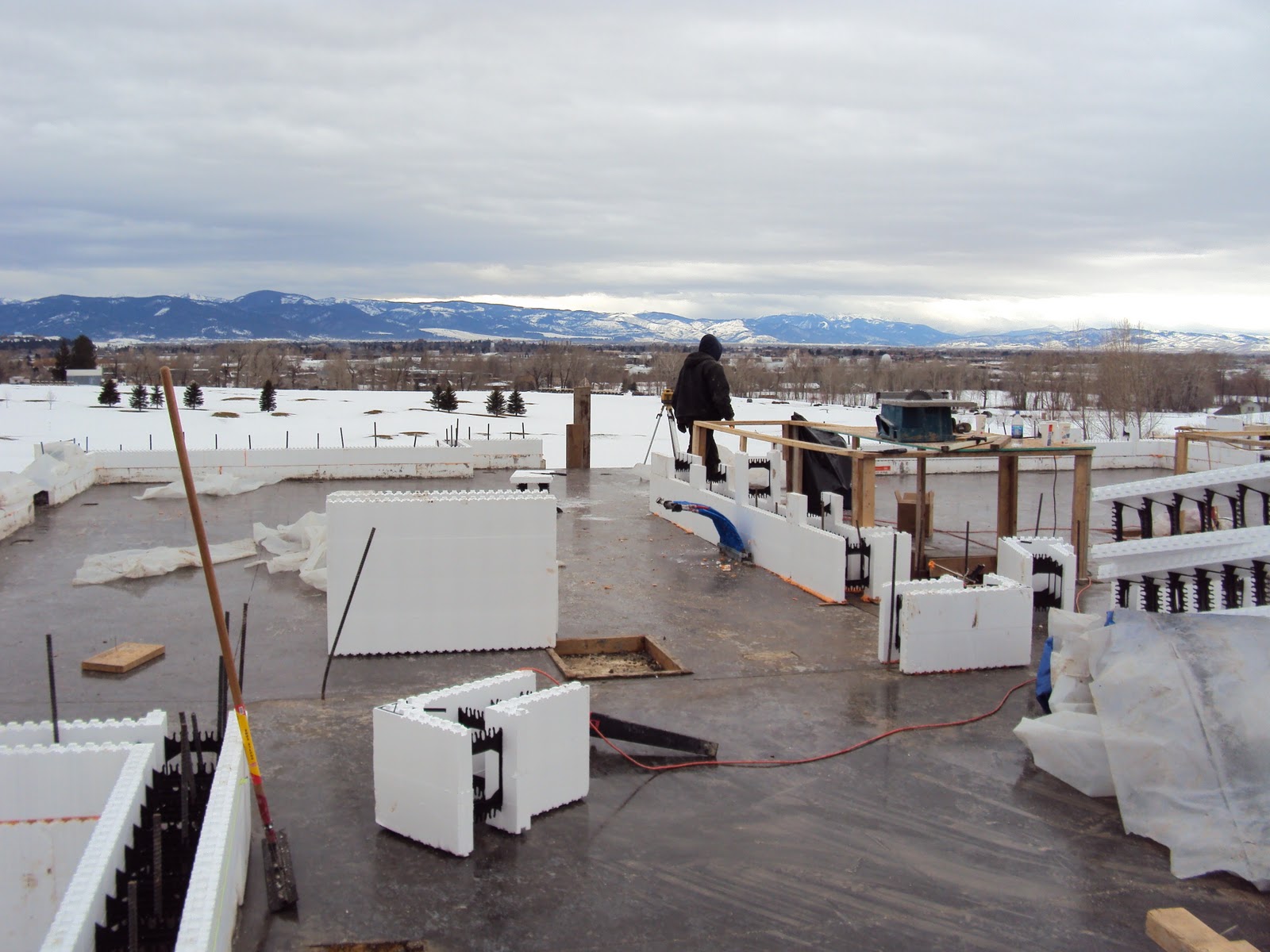
With the bitter cold setting in the weekend of January 29th, the contractor could not begin the installation of the Amvic ICF walls on the first floor until February 4th. As I am writing, the snow is coming down and accumulating, which will push the completion of the Amvic wall installation into the week of February 14th. If weather permits, the walls will also be poured with concrete the same week, and students from Montana State University's Mechanical Engineering School will place additional sensors in the walls.

Once the Amvic walls are complete, the wood truss joist will be put in place to support the second floor. After that, installation of the structural insulated panel (SIP) walls, followed by the SIP roof, will begin.


January 24, 2011

Installation of First Floor Nearing Completion

By Bill Hoy, Project Manager

As January moves on, progress continues onsite at the REHAU Montana ecosmart house.

During the week of the 17th, the first floor AmDeck forms were installed and the first floor will be completed this week with the final concrete pour. The subcontractor also completed 80% of the rebar (reinforcing bar) placement on the first floor of the house.

Preparation is also underway to place plumbing rough-ins, and sensors are being placed by the mechanical engineering students at Montana State university. Once the house is finished and occupied, these sensors will collect data that will be evaluated to determine how the various systems being used throughout the house contribute to energy consumption and comfort day-to-day.


January 7, 2011

AmDeck Flooring System Installation Continues; Radiant Heating Installation Begins

By Bill Hoy, Project Manager

Workers installing the RAUPEX pipe for the radiant heating system on Friday, January 7. 

Happy New Year! We are looking forward to a great 2011 here in Montana. As this first week of January comes to a close, the weather is cooperating. We warmed up to 27 degrees after having below-zero temperatures the last week of the year, making it possible for work to continue on the AmDeck flooring system installation. 

The installation will be completed in two sections. The first will be the garage floor and section two will be the remainder of the first floor area. The concrete pour for the first section should be complete by the middle of next week. (Read about the AmDeck insulated concrete forms (ICF) flooring system here.)

In addition, installation of radiant heating has begun. Workers are onsite today laying out the RAUPEX crosslinked polyethylene (PEXa) pipe, which will be embedded in the concrete and suspended wood floors of the home. A heat transfer fluid will be circulated through this pipe system, which will be connected to the geothermal heat pump system. (Read about the REHAU radiant heating system here.)

Watch the progress live onsite with the interactive webcam: http://209.181.6.25/sample/nuspectra/.